


Types of Samples in Garment Industry: 10 Samples Explained
Noor Ahmed Raaz
Specialized in Apparel Manufacturing
Owner and Editor in Chief Textile Merchandising
Asst. Prof., Department of Textile Engineering
Atish Dipankar University of Science & Technology
Email: textilemerchandising1@gmail.com
Ask any experienced merchandiser what actually carries an order from enquiry to shipment, and the answer is rarely the email or the tech pack. It is the samples. A sample is the physical language between a buyer and a factory. Words in a spec sheet can be read two ways, a sketch can be misunderstood, but a stitched garment sitting on the table says exactly what both sides mean.
What surprises most juniors is how many samples one single style needs. Before a single bulk piece is cut, and even while production is running, a style may go through 8 to 12 different samples. Each one has a different purpose, a different moment in the order cycle, and often a different party paying for it. Mixing them up, skipping a stage, or sending the wrong sample at the wrong time is one of the most common reasons orders get delayed before they even start.
In this guide I will walk you through every sample type you will meet as a merchandiser what it is for, when it is made, what fabric and trims it uses, and who approves it.
What Is a Garment Sample?
A garment sample is a trial piece (or a small set of pieces) made before or during bulk production to represent how the final garment will look, fit, and be constructed. It is made by the sample section of the factory, usually by the most skilled operators on the floor, following the buyer’s tech pack, measurement chart, and construction details.
A sample is not just a smaller version of production. It is a decision-making tool. Almost every important decision in an order price confirmation, design approval, fit approval, and production go-ahead is taken while looking at a sample.
Why Sampling Matters So Much
Sampling does three jobs that nothing else in the process can do.
First, it builds the approval chain. A buyer sitting in another country cannot visit your sewing floor every week. The approved sample becomes their eyes and hands: if the sample is approved, the factory has permission to proceed to the next stage.
Second, it makes costing accurate. A proto sample tells the merchandiser the real fabric consumption, the actual sewing time, and which operations are difficult. Costing done only from a sketch is guesswork; costing done after sampling is a business decision.
Third, the approved sample becomes the production standard. When a dispute comes up later a shade argument, a measurement claim both sides go back to the approved and sealed sample. That is why sample handling is treated so seriously in a well-run factory.
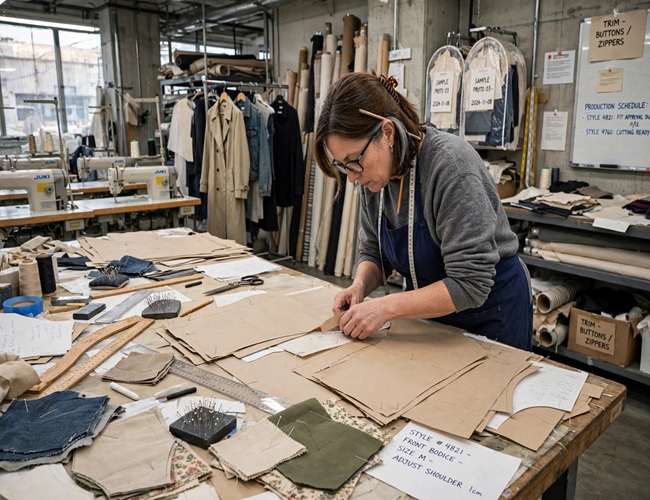
The sample room is where every order really begins patterns are made and corrected here long before bulk cutting.
The Main Types of Samples in the Garment Industry
1. Proto Sample (Prototype / Development Sample)
The proto sample is the very first physical version of the style, made from the buyer’s tech pack, sketch, or sometimes just a photograph or an original garment the buyer sends as a reference. Its job is simple: to show the buyer that the factory has understood the design, the silhouette, and the construction.
Because the actual bulk fabric is rarely available at this stage, the proto is usually made in a substitute fabric something close in weight, structure, and feel to the final fabric. Trims are also whatever is available in the sample room. Nobody judges colour or final fabric quality on a proto; they judge design lines, proportions, stitching details, and workmanship.
Expect the proto to come back with comments and to be revised two or three times. That is normal. Each round moves the style closer to what the buyer pictured, and each round also sharpens the costing.
2. Fit Sample
Once the design direction is accepted, the buyer wants to know: does it fit? The fit sample is made specifically to check fit and measurements, normally tried on the buyer’s fit model or a dress form of the standard size.
The fit sample may still be in substitute fabric, though actual fabric is preferred when available, because fabric stretch and drape change how a garment sits on the body. The buyer’s technical team measures every point of measure against the spec and returns a fit comment sheet chest up by half an inch, armhole deep, shoulder slope corrected, and so on.
A style may need more than one fit round. Never treat fit comments casually: every corrected measurement here becomes the foundation of the final measurement chart used in production and inspection.
3. Size Set Sample
A garment that fits perfectly in size M can still go wrong in S or XL if the grading is poor. The size set sample answers that question. It is one piece in every size of the order for example S, M, L, and XL made to check that the grade rules between sizes are correct and that proportions stay balanced across the range.
Size set samples are usually made in actual fabric, because by this stage fabric is normally in-house or confirmed. The buyer or their technical team measures all sizes, checks that the jump between sizes is even, and approves the full size range not just the base size.
The size set is generally prepared before the PP sample or submitted together with it, so that no grading surprise appears after production approval.
4. Pre-Production Sample (PP Sample)
This is the most important sample in the whole process. The PP sample is made with the actual bulk fabric, actual trims, actual labels, and the actual packing method exactly as the bulk production will run. Nothing is substituted. If the bulk fabric is a specific washed denim, the PP sample is in that denim with that wash. If the order needs a particular branded button, it is on the PP sample.
The PP sample is normally made in two or three sets: one for the buyer, one for the factory sample room, and one for the QC team or buying office. The buyer checks everything against the tech pack fabric, shade, measurements, workmanship, labels, barcodes, folding, and polybag.
The rule every merchandiser must remember: bulk cutting cannot start without PP approval. Cutting fabric before PP approval is one of the riskiest mistakes a factory can make, because any change after cutting becomes a financial loss.
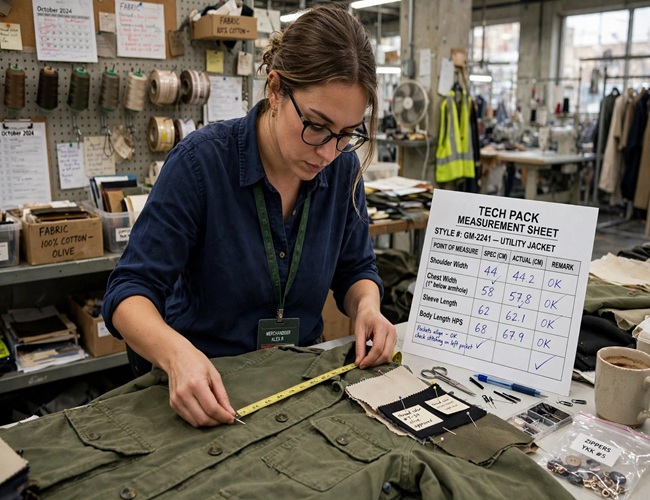
Every point of measure is checked against the tech pack before a sample is sent for approval.
5. Counter Sample
When the buyer approves a sample and returns one signed or marked set to the factory, the factory keeps its own retained copy this is the counter sample. “Counter” simply means the factory’s counterpart of the buyer’s approved set.
The counter sample stays in the sample room or with the production QC, clearly tagged with style number, buyer, and approval date. During bulk production, supervisors and inline QC compare running production against the counter sample whenever a question comes up: Is this stitch density right? Is this the approved shade of thread? The counter sample is the answer, not somebody’s memory.
6. Salesman Sample (SMS)
The salesman sample exists for selling, not for production approval. Once a style is developed, the buyer’s sales team needs real garments to show retailers and collect orders. SMS are therefore made in all colours and usually a full or representative size range, finished to production quality correct fabric or the closest possible, proper labels, pressed and hung properly.
Because a buyer’s sales team may cover many stores and regions, the quantity of SMS is larger than any other sample type, and the deadline is strict: if the samples miss the sales meeting, the style may never be ordered at all. Merchandisers plan SMS production almost like a small bulk order.
7. Photo Shoot Sample
Photo shoot samples are made for catalogues, lookbooks, and e-commerce photography. They must look perfect on camera: no loose threads, no pressing marks, no sample tags, beautifully steamed, with the best possible finish.
They are usually made in one core size the size that fits the model and are often taken from the best pieces of the SMS or PP stage output, or made separately if photography is scheduled early. Treat them gently: a photo sample that comes back from the studio wrinkled or stained has still done its job, but one that never reaches the studio on time can delay the whole online launch.
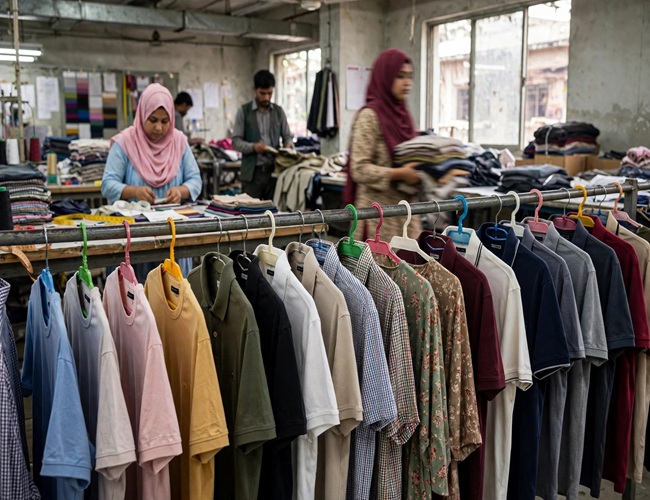
Salesman and photo shoot samples are kept on rails in the sample room, organised by buyer and season.
8. TOP Sample (Top of Production Sample)
The TOP sample, also called the production sample, is taken from the actual bulk production line the first finished pieces that come off the sewing floor once bulk production starts. It is not made by the sample room; it comes out of real production, with real operators, real machines, and real bulk fabric.
The TOP sample is sent to the buyer to confirm that the bulk matches the approved PP sample. If production has drifted a measurement creeping out, a shade band appearing the TOP is where the buyer catches it early, while correction is still cheap. Smart merchandisers never wait for the TOP to discover a problem; they compare line output against the counter sample daily.
9. Shipment Sample
The shipment sample is taken from the final packed goods literally pulled from finished cartons and sent to the buyer when the goods ship. It represents exactly what is inside the shipment: same fabric, same packing, same labels, same folding.
Buyers compare the shipment sample with what arrives at their warehouse. If a claim ever arises about what was actually shipped, the shipment sample is part of the evidence. Choose these pieces randomly from packed cartons; hand-picking the best pieces defeats the entire purpose and can create a bigger problem later.
10. Sealing Sample (Gold Seal Sample)
The sealing sample is the finally approved PP sample that the buyer, or their nominated QC, seals with a special tag, stamp, or seal and signs across it. Many merchandisers know it as the gold seal sample.
Its role is legal as much as technical. The sealed sample is the undisputed reference standard: in any later dispute about shade, measurement, workmanship, or trims, the sealed sample decides who is right. Because of that, sealed samples are stored carefully protected from light and dust so the colour does not fade and are never used for any other purpose.
So the relationship is this: the PP sample is what you submit; once approved and sealed, that same sample becomes the gold seal, and its factory copy works as the counter sample on the production floor.
Summary Table: All Sample Types at a Glance
|
Sample Type |
Stage |
Made With |
Purpose |
|
Proto |
Development |
Substitute |
Check |
|
Fit |
Development |
Substitute |
Check fit and measurements on |
|
Size |
Pre-production |
Actual |
Verify |
|
PP |
Pre-production |
Actual |
Final approval before bulk |
|
Counter |
Pre-production |
Same as |
Factory’s |
|
Salesman |
Selling season |
Production-quality |
Buyer’s sales team collects |
|
Photo |
Marketing |
Best-finish |
Catalogue |
|
TOP |
Early bulk production |
Actual |
Confirm bulk matches approved |
|
Shipment |
Shipment |
Pieces |
Represent |
|
Sealing |
After PP approval |
The |
Sealed legal reference standard |
The Sample Approval Flow, Step by Step
The sequence below is the path almost every order follows:
- Development: Tech pack received → proto sample made and sent → buyer comments → revised proto if needed.
- Fitting: Fit sample submitted → fit comments and corrected measurement chart returned → pattern corrected.
- Size confirmation: Size set sample in all sizes → grading approved.
- Pre-production: PP sample in actual fabric and trims → PP approval received → sample sealed (gold seal), counter sample kept by the factory.
- Selling (parallel track): SMS and photo shoot samples delivered to the buyer’s sales team and studio.
- Production: Bulk starts only after PP approval → TOP sample from the line sent and approved.
- Shipment: Final inspection passed → shipment sample pulled from cartons and sent with shipment documents.
Notice the parallel track: selling samples often run alongside approval samples, which is why the sample room feels busy from two directions at once.
Who Pays for Samples?
This question comes up in almost every new buyer relationship, and the honest answer is: it depends on the buyer and the sample type but some patterns are common.
Development samples (proto and fit rounds) are often made free of charge, or charged at a nominal sample fee, because the factory treats them as the cost of winning the order. Salesman samples are usually charged, since they are ordered in quantity and the buyer keeps and uses them for selling. Photo shoot samples are commonly billed with the SMS.
Whatever is not charged directly is normally recovered inside the bulk price sample cost, courier cost, and sample-room time are real expenses, and experienced merchandisers build them into the costing quietly rather than arguing about them later. What matters most is that the arrangement is clear and written down before sampling starts, not after the courier bills arrive.
Common Sampling Mistakes That Delay Orders
Most sampling delays I have seen were not caused by the buyer. They were self-inflicted:
- Substituting fabric silently. Using a substitute fabric is fine for a proto using one without telling the buyer is not. If the substitute behaves differently, every comment that follows is built on a lie.
- Ignoring the last comment sheet. Sending a revised sample without applying the previous fit comments wastes a full courier cycle. Work through the comments point by point and tick them off.
- Sending unpressed, unlabelled samples. A wrinkled sample with no style number, no size label, and no hang tag creates a poor impression and real confusion at the buyer’s end.
- Skipping the size set. Approving size M and assuming the grading will look after itself is how factories end up with a perfect M and an unwearable XL.
- Cutting bulk before PP approval. The costliest mistake of all. However confident you feel, wait for the approval.
FAQ
How many samples are needed for one garment style? Typically 8 to 12 samples across the whole order cycle proto (often 2–3 rounds), fit, size set, PP, counter, SMS, photo shoot, TOP, and shipment samples. Simple repeat styles need fewer; new developments need more.
What is the difference between a PP sample and a sealing sample? They are usually the same physical garment at two moments in its life. The PP sample is submitted for approval; once the buyer approves and seals it with a tag or stamp, it becomes the sealing (gold seal) sample the legal reference standard.
Can bulk production start before PP approval? No. PP approval is the buyer’s confirmation that fabric, trims, measurements, and packing are all correct. Cutting bulk before it risks the whole order if the buyer requests any change.
What is the difference between a TOP sample and a shipment sample? The TOP sample comes from the first output of the bulk line, early in production, so the buyer can confirm bulk matches the PP sample. The shipment sample is pulled from packed cartons at the end and represents exactly what was shipped.
Who pays for salesman samples? In common practice, SMS are charged to the buyer because they are produced in quantity for the buyer’s own sales activities, while early development samples are often free or billed nominally. The exact arrangement should be agreed in writing before sampling begins.
Conclusion
Samples look like a small part of garment merchandising, but they carry the whole order. The proto wins confidence, the fit sample wins the measurements, the PP sample wins permission to produce, and the sealed sample protects everyone at the end. Learn what each sample is for, respect the sequence, and never send a sample you would not be happy to see turned into ten thousand pieces because that is exactly what an approved sample becomes.

Mohammad Noor Nabi, known by his author name Noor Ahmed Raaz, is a PhD Fellow at Bangladesh University of Textiles (BUTEX) and the Founder & Editor of Textile Merchandising. He is also an Assistant Professor of the Textile Engineering Department at a renowned university in Dhaka, Bangladesh. His research focuses on textile innovation and sustainability. Awarded the Research & Development Fellowship thrice from the Ministry of Science & Technology in Bangladesh, Noor Ahmed Raaz is dedicated to advancing textile engineering through education, research, and industry collaboration. For inquiries or collaborations, contact Noor Ahmed Raaz via email at textilemerchandising1@gmail.com or WhatsApp at +8801673758271.