


Smart Textiles and E-Textiles: How Fabrics Learned to Sense, React and Communicate
Noor Ahmed Raaz
Specialized in Apparel Manufacturing
Owner and Editor in Chief Textile Merchandising
Asst. Prof., Department of Textile Engineering
Atish Dipankar University of Science & Technology
Email: textilemerchandising1@gmail.com
A normal T-shirt does one job: it covers you. Now imagine a T-shirt that also measures your heart rate while you train, warns a nurse if a patient’s breathing slows at night, or warms itself on a cold morning. The fabric is still soft and washable but it has quietly become an electronic device.
That is the world of smart textiles, also called e-textiles. For textile students and merchandisers, this is no longer a futuristic side topic buyers already ask about connected garments. In this article, I will explain what smart textiles are, how they are built, which real products exist, where they are used, and what problems still hold them back.
What Are Smart Textiles and E-Textiles?
A smart textile is a fabric that can sense, react or communicate. An e-textile (electronic textile) has electronic parts built in conductive fibres, sensors, tiny microcontrollers and wireless modules woven, knitted, printed or embroidered directly into the textile structure.
The key word is “into”. A fitness tracker clipped onto your shirt is a gadget attached to clothing. In an e-textile, the clothing itself is the device: the yarn carries the signal, the fabric is the sensor. People forget to charge and wear a wristband. They rarely forget to get dressed.
According to Reports and Data, the dwas valued at about USD 4.83 billion in 2025 and is forecast to grow at a CAGR of about 13.2%, reaching roughly USD 16.72 billion by 2035. One honest note: market estimates vary between research firms, because some count only the fabric and others count the whole garment and its software. The direction, though, is the same — strong growth.
The Three Levels of Smart Textiles
Textile engineers usually classify smart textiles into three levels, based on how much the fabric can do.
1. Passive Smart Textiles
These can only sense. A shirt with built-in heart-rate electrodes collects information about the body, but it does not respond to what it finds. Most commercial products today sit at this level.
2. Active Smart Textiles
These can sense and react. A jacket made with phase-change materials absorbs heat when you are warm and releases it when you cool down. Heated gloves and jackets with built-in heating elements also belong here: they detect cold, and they act.
3. Very Smart (Ultra Smart) Textiles
These sense, react and adapt. They carry a processor, and increasingly some form of AI, so the garment can learn the wearer’s patterns and adjust itself. A training shirt that learns your usual heart-rate response and warns you earlier each time you approach your limit would be one. This level is still mostly in research labs, but it is where the technology is heading.
Inside a Smart Garment: The Key Components
Every e-textile, simple or advanced, is built from the same basic ingredients. If you understand these five parts, you understand the whole field.
|
Component |
Examples |
Job It Does |
|
Conductive |
Silver-coated |
Carry |
|
Sensors |
ECG/heart-rate electrodes, |
Collect |
|
Power |
Thin |
Runs |
|
Controller |
Tiny microcontroller, Bluetooth |
Processes |
|
Actuators |
Heating |
Produce |
A few practical points from the factory side. The conductive yarn is the backbone. Silver-coated nylon is popular because it conducts well and feels reasonably soft, but it costs far more than normal yarn and needs careful handling on the knitting machine. Sensors are often not separate parts at all a knitted electrode is simply a patch of conductive yarn in a special structure that sits against the skin. The one part that still looks like “electronics” is the control unit, usually a removable pod that snaps onto the garment so the fabric part can be washed.
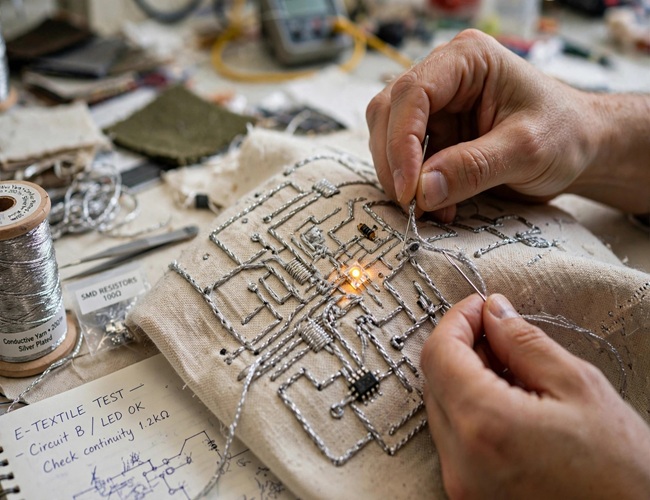
Conductive yarns and embroidered circuits turn ordinary fabric into a working electronic system.
How Smart Textiles Are Made
There are four main routes to putting electronics into fabric, and factories often combine them.
Conductive yarns in weaving and knitting. Conductive yarns are fed into the machine like normal yarns and placed exactly where the circuit or sensor needs to be. This gives the most “textile” feel, because the electronics are part of the structure itself.
Embroidery. A standard industrial embroidery machine, loaded with conductive thread instead of polyester thread, can stitch a circuit, an antenna or a sensor pattern onto finished fabric. This is flexible and suits small production runs.
Printed electronics. Conductive inks are screen-printed onto fabric in circuit patterns. Printing is fast and cheap for simple sensors, though the print must survive stretching and washing.
Lamination. Flexible sensor films are bonded onto or between fabric layers. This protects the electronics well, but it can make the fabric stiffer.
Real Products You Can Buy (or Read About) Today
Smart textiles can sound like science fiction until you see what is already on the shelves.
- Hexoskin smart shirts track heart rate (ECG), breathing and activity. Used by sports researchers, and even studied for health monitoring in space medicine programs.
- Sensoria smart socks measure foot pressure and walking pattern. Runners use them to improve form, and doctors are testing them for diabetic foot care, where unnoticed pressure spots can turn into wounds.
- Myant’s Skiin platform puts sensing technology into underwear and everyday garments that track heart health and activity.
- The Owlet smart sock wraps around a baby’s foot and monitors oxygen level and heart rate, alerting parents if something looks wrong.
- Heated jackets from workwear brands such as Milwaukee and ORORO use battery-powered heating zones a classic active smart textile that many construction workers already know.
- Toray’s hitoe conductive fabric from Japan is woven with nanofibre-coated yarns and is used in health-monitoring garments that can read ECG signals.
The pattern is clear: the successful products solve a real problem for a specific group. The fashion pieces that light up get attention on runways, but they are not yet a real business.
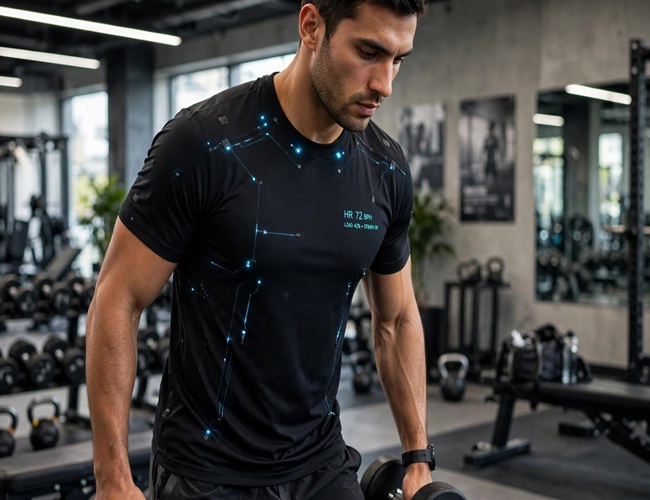
A smart training shirt records heart rate and movement while the athlete simply wears it.
Where Smart Textiles Are Used
Healthcare and Remote Patient Monitoring
This is the biggest growth driver in the market. Hospitals and home-care services want to monitor patients without tying them to machines. A smart shirt can track heart activity, breathing and temperature through the night and send the data to a nurse’s screen. With an ageing population the WHO projects about 2.1 billion people aged 60 or older by 2050 wearable monitoring is becoming a real need, and I expect medical applications to lead this market for years.
Sports and Fitness
Athletes were the early adopters. Teams use e-textiles to track workload, recovery and breathing during training, which helps coaches prevent injury. The sensors sit in the garment, so the athlete feels nothing extra.
Military and Defence
Armies are testing uniforms that monitor a soldier’s vital signs and location, and fabrics that carry communication devices without bulky cables. Defence budgets fund much of the early research in this field.
Automotive
Car seats with integrated heating and occupancy sensors are already common. The next step is seats that sense driver fatigue through posture and breathing.
Fashion and Entertainment
Designers use light-emitting and colour-changing textiles for stage costumes and statement pieces. It is a small market, but it gives the technology a lot of visibility.
Industrial Safety Workwear
Factories are testing workwear th mngh m m at detects gas exposure, dangerous body temperatures or falls. A shirt that raises an alarm before heatstroke sets in can save lives.
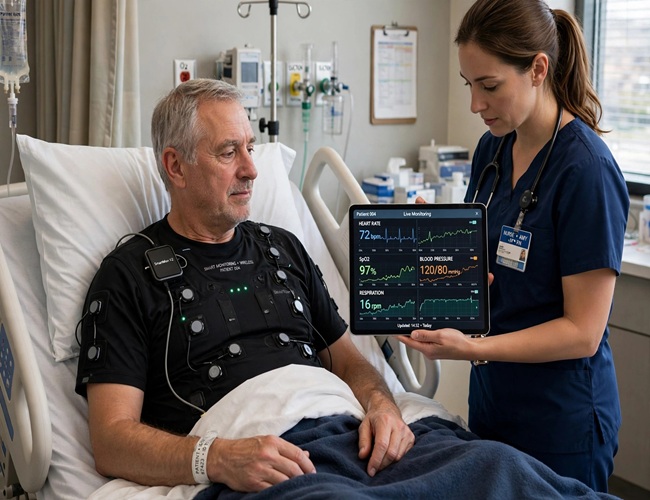
In hospitals, smart shirts let nurses watch a patient’s vital signs without wires tying the patient to a machine.
The Challenges Nobody Should Hide
Now the problems they are real, and any honest article should list them.
Washability. This is the number-one challenge. Electronics hate water and detergents; garments must be washed. Most products survive dozens of washes now, but a normal shirt lasts hundreds. Buyers will ask you: “How many washes is this guaranteed for?” Have an answer ready.
Batteries and power. Batteries are still the weak link bulky, need charging, and many people are uneasy about wearing a lithium battery. Energy harvesting from movement, sunlight or body heat is improving, but it cannot yet run a power-hungry system on its own.
Comfort and cost. A smart garment must feel like a garment first. If the electronics make it stiff, heavy or uncomfortable, nobody wears it. And prices are still premium: conductive yarns, development and testing push costs far above a normal T-shirt, and small volumes keep them high.
Data privacy. A shirt that records your heartbeat all day collects sensitive health data. Who stores it? Who can see it? Employers issuing smart workwear need very clear rules, and health-data laws apply in many countries.
E-waste and recycling. Here is the uncomfortable link to the sustainability debate. A garment with electronics inside is much harder to recycle than a plain cotton shirt you cannot throw circuit boards into a textile shredder. The industry still has no good answer for end-of-life e-textiles.
No common standards. There are still no widely accepted test methods for things like wash durability of sensors or the accuracy of knitted ECG electrodes. Without standards, every manufacturer tests differently, and buyers cannot easily compare products.
The Future: What Comes Next
Even with those challenges, the direction is clear. Conductive yarns are getting more washable and cheaper every year. Energy harvesting will shrink batteries or remove them from low-power garments. Medical and defence will carry the market first, because those customers pay for performance — then sports, and fashion last, once prices fall and comfort improves.
The most interesting change may be invisible: smart textiles connecting to health platforms and AI coaching apps. The shirt becomes just the sensor; the real value is the advice the software gives you. For merchandisers, this means a new skill set is coming tomorrow’s buyer may ask for data security certificates and wash-cycle guarantees alongside fabric specs.
Frequently Asked Questions
Are smart textiles washable?
Yes, within limits. Most commercial smart garments survive dozens of wash cycles if you follow the care instructions usually meaning you remove the electronic pod first. Always check the manufacturer’s wash guarantee.
What is the difference between smart textiles and a smartwatch?
A smartwatch is a device you wear; a smart textile is clothing that works as the device. E-textiles measure through the fabric across larger body areas, feel like normal clothing, and can monitor you all day without anything strapped on.
Are e-textiles safe to wear?
Marketed products pass normal textile safety standards plus electronics checks, and sensing currents are tiny. The bigger question is batteries reputable products use certified battery units.
Why are smart garments so expensive?
Three reasons: the materials (conductive yarns cost far more than normal yarn), the development (electronics and software design), and the scale (small runs mean no economies of scale yet). Prices should fall as volumes grow.
Will smart textiles replace regular clothing?
No. A normal T-shirt does its job perfectly well. Smart textiles will grow where sensing adds real value health, sports, safety, defence while most everyday clothing stays simple and cheap. Not every problem needs a sensor.
Conclusion
Smart textiles give the oldest human technology clothing new senses. Real products already help athletes, patients and workers, but it is still an early industry with real problems around washing, batteries, cost, privacy and recycling.
For textile students and merchandisers, my advice is simple: learn the basics now the components, the three levels of smart textiles, and what buyers will ask about: wash durability, data rules, certifications. When a customer walks in asking for a connected garment, be the person in the room who already knows how it works.

Mohammad Noor Nabi, known by his author name Noor Ahmed Raaz, is a PhD Fellow at Bangladesh University of Textiles (BUTEX) and the Founder & Editor of Textile Merchandising. He is also an Assistant Professor of the Textile Engineering Department at a renowned university in Dhaka, Bangladesh. His research focuses on textile innovation and sustainability. Awarded the Research & Development Fellowship thrice from the Ministry of Science & Technology in Bangladesh, Noor Ahmed Raaz is dedicated to advancing textile engineering through education, research, and industry collaboration. For inquiries or collaborations, contact Noor Ahmed Raaz via email at textilemerchandising1@gmail.com or WhatsApp at +8801673758271.