


Yarn Count Systems and Conversions: Ne, Tex, Denier and Nm Explained
Noor Ahmed Raaz
Specialized in Apparel Manufacturing
Owner and Editor in Chief Textile Merchandising
Asst. Prof., Department of Textile Engineering
Atish Dipankar University of Science & Technology
Email: textilemerchandising1@gmail.com
If you have ever looked at a yarn specification and wondered what “30 Ne” or “150 denier” actually means, you are not alone. Yarn count systems confuse most textile students not because the maths is hard (the formulas are simple), but because we use several systems at once, and in one of them a bigger number means a finer yarn, while in the other it means the opposite.
In this article I will walk you through both systems with clear definitions, a conversion table for your desk, and worked examples for every formula. Once you see the pattern, you will never mix them up again.
What Is Yarn Count?
Yarn count is simply a number expressing how fine or coarse a yarn is. Because you cannot measure yarn “fineness” with a ruler, the industry expresses it as a ratio: either mass per unit length, or length per unit mass. Think of it as the yarn world’s shoe size a standard number everyone in the supply chain can quote, buy and test against.
Every count system belongs to one of two families, and this is the first thing to get straight:
- Direct system: The count is mass per fixed length. The count rises as the yarn gets coarser (heavier).
- Indirect system: The count is length per fixed mass. The count rises as the yarn gets finer.
The memory trick: direct = direct relationship bigger number, bigger yarn. Indirect = inverse relationship bigger number, finer yarn.
The Direct System: Tex, Denier and dtex
In the direct system, we take a fixed length of yarn and weigh it. A heavier yarn gives a bigger number, so a higher count means a thicker, coarser yarn. The three common direct systems are:
- Tex : Grams per 1,000 metres. The universal system you will see most in modern specifications: 20 tex means 20 grams per kilometre.
- Denier: Grams per 9,000 metres, used mainly for filament yarns and silk.
- dtex (decitex): Grams per 10,000 metres, a finer division of tex popular in Europe. 1 tex equals 10 dtex.
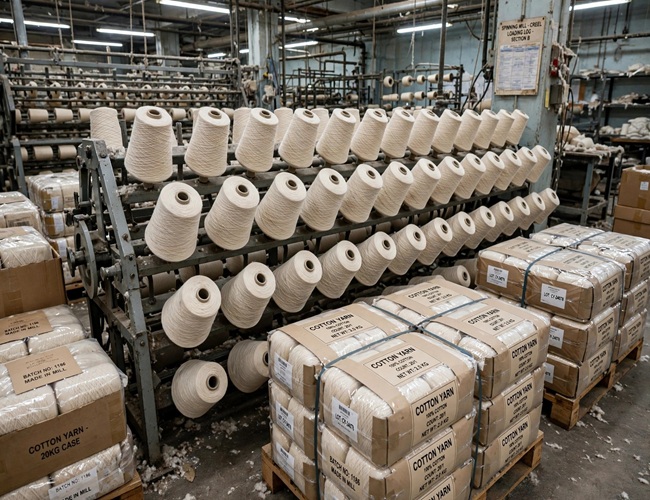
Yarn cones in a spinning mill every package is labelled with its count, so the whole supply chain speaks the same language.
The Indirect System: Ne, Nm, Worsted and Linen Counts
In the indirect system, we take a fixed mass of yarn and measure its length. A finer yarn gives more length per gram, so a higher count means a finer, thinner yarn:
- English cotton count (Ne): The number of 840-yard hanks that weigh one pound. The classic system for cotton, and still the most quoted count in garments: 30 Ne means thirty 840-yard hanks (25,200 yards) weigh one pound.
- Metric count (Nm): Kilometres of yarn per kilogram. Neat and logical: 50 Nm is 50 kilometres per kilogram.
- Worsted count: The number of 560-yard hanks per pound, used for combed wool yarns.
- Linen count: The number of 300-yard leas per pound, used for linen and hemp.
The pattern is always “how much length fits into a fixed weight”. More length in the same pound means finer yarn that is why 40 Ne is finer than 30 Ne, the fact that trips up almost every beginner.
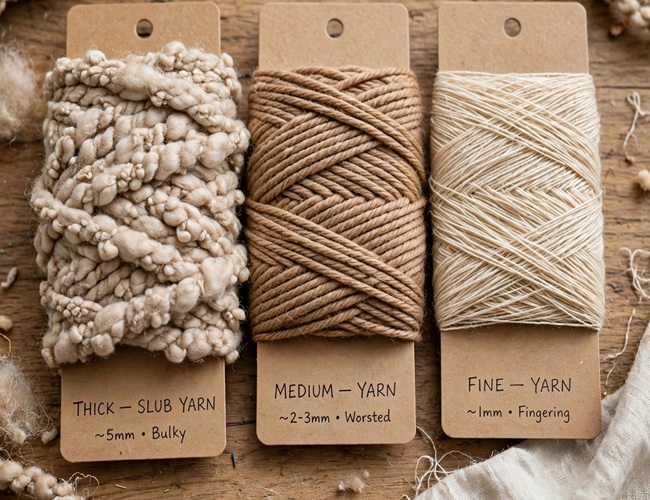
Same fibre, different counts: the thickness you see here is what the count number is really telling you.
Conversion Formulas
You will convert constantly, especially when a buyer specs in tex but the spinner quotes in Ne. Keep these formulas:
|
Conversion |
Formula |
|
Ne to |
tex = |
|
tex to |
Ne = 590.5 / tex |
|
tex to |
denier |
|
tex to |
Nm = 1,000 / tex |
|
Ne to |
Nm = |
|
Ne to |
denier = 5,315 / Ne |
Two notes. First, the 590.5 constant is specific to the cotton Ne system — it comes from the 840-yard hank and the pound. Do not use it for worsted or linen counts; each system has its own constant. Second, denier is simply 9 times tex, because 9,000 metres is 9 times 1,000 metres that logic will rescue you if you ever forget the formula.
Ready Conversion Table
Rather than calculating every time, keep this table near your desk:
|
Ne (cotton count) |
tex |
denier |
Nm |
|
10 |
59.1 |
531 |
16.9 |
|
20 |
29.5 |
266 |
33.9 |
|
30 |
19.7 |
177 |
50.8 |
|
40 |
14.8 |
133 |
67.7 |
|
50 |
11.8 |
106 |
84.7 |
|
60 |
9.8 |
89 |
101.6 |
Look down the tex column as Ne rises: 59.1, 29.5, 19.7, 14.8… The tex number falls while Ne climbs the inverse relationship in action. That is why a 60 Ne yarn (9.8 tex) is so much finer than a 10 Ne yarn (59.1 tex).
Worked Example 1: Converting 30 Ne Cotton Yarn
Let us convert the industry workhorse, 30 Ne cotton yarn:
- tex = 590.5 / 30 = 19.7 tex
- denier = 19.7 x 9 = 177 denier
- Nm = 1.693 x 30 = 50.8 Nm
One and the same yarn can be described as 30 Ne, 19.7 tex, 177 denier or 50.8 Nm. The yarn does not change only the measuring language does.
Worked Example 2: A 150 Denier Polyester Filament
A buyer sends a specification calling for 150 denier polyester filament, but your spinner quotes everything in Ne. Convert it:
- tex = 150 / 9 = 16.7 tex (remember: denier is 9 times tex, so tex is denier divided by 9)
- Ne = 590.5 / 16.7 = 35.4 Ne
The equivalent spun count is about 35 Ne. Denier is the natural language for filament yarns you would rarely see a spinner quote one in Ne but knowing the conversion keeps you fluent in both worlds.
Worked Example 3: Measuring Count in the Lab
Sometimes you receive a yarn with no label and must determine its count yourself. This is the skein method, and every textile lab knows it:
- Condition the yarn at 20 ± 2 °C and 65 ± 2 % relative humidity — natural fibres absorb moisture, and moisture changes the weight.
- Wind a skein of fixed length on a wrap reel (for example, 100 metres).
- Weigh the skein on an analytical balance. Suppose our sample weighs 2.0 grams.
- Calculate: tex = (2.0 / 100) x 1,000 = 20 tex.
- Convert: Ne = 590.5 / 20 = 29.5, i.e. about 30 Ne.
The tools are simple wrap reel and analytical balance but the conditioning step is what separates a proper test from a guess. An unconditioned yarn can easily read a count or two off.
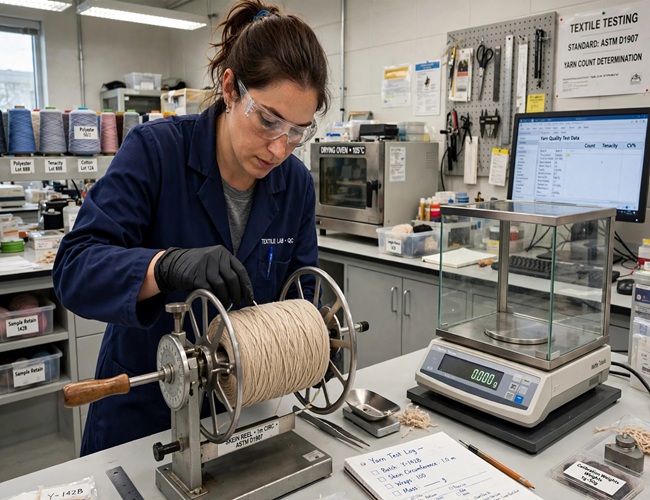
The skein method in practice: a fixed-length skein from the wrap reel is weighed on the analytical balance to determine yarn count.
Typical Yarn Counts for Common Products
Coarse, durable products sit at low Ne numbers; fine, lightweight products sit at high ones.
|
Product |
Typical count range |
|
Denim warp yarn |
7-16 Ne |
|
Towels |
10-20 Ne |
|
Bed sheets |
20-40 Ne |
|
T-shirts (single jersey) |
26-40 Ne |
|
Fine dress shirts |
50-80 Ne |
One exception: sewing threads are commonly sold in tex or by ticket numbers rather than Ne, so check which language the spec uses before comparing threads.
Why Yarn Count Matters So Much
Count is not an academic number. It decides how your fabric looks, feels and costs:
- Fabric weight (GSM) — a coarser yarn in the same structure gives a heavier fabric. Swap 30 Ne for 24 Ne at the same machine settings and the GSM jumps with it — and a few grams per square metre can break a buyer’s tolerance.
- Appearance and hand feel — finer yarns give a smoother, denser, more polished surface. The reason a 60 Ne shirting feels “premium” and a 20 Ne one doesn’t is largely the count.
- Price — finer yarns cost more to spin (more drawing, more twist, less output per spindle) and use finer, dearer fibres, so yarn and fabric prices climb as count rises.
- Machine settings — knitting gauge is chosen to match yarn count. A yarn too coarse for the gauge means breakage, holes and dropped stitches.
- Buyer claims — the one merchandisers fear most. If a supplier delivers 28 Ne instead of the 30 Ne you paid for, the fabric misses its target GSM, the consumption and costing go wrong, and the buyer raises a claim. That is why consumption and costing always start from a verified count.
Two digits on a spec sheet quietly control the weight, quality and profit of the whole order.
Common Student Confusions (and how to avoid them)
- “A bigger number means a coarser yarn.” Only in the direct system. In the indirect system (Ne, Nm), a bigger number means a finer yarn: higher number = heavier yarn in direct systems, lighter yarn in indirect ones.
- Using the 590.5 constant for every yarn. 590.5 converts between Ne (cotton) and tex. The worsted count (560-yard hanks) and linen count (300-yard leas) have different hank lengths, so different constants. Check which system you are converting before you divide.
- Quoting spun yarn in denier. Denier is the language of filament yarns and silk; spun yarns such as cotton are described in Ne or tex. Writing “150 denier cotton yarn” in a spec is a red flag to any spinner.
- Ignoring moisture when weighing. Count is weight-based, and wet yarn weighs more. Always condition before testing, or your “30 Ne” may really be 29 Ne.
How Count Is Tested and Graded
The skein method from Example 3 is the basic test in every mill laboratory: condition the sample, reel a fixed-length skein on the wrap reel, weigh it on the analytical balance, then calculate tex (or denier) and convert to the specified system.
A single count number is not the whole quality story. The lab also checks count CV% the coefficient of variation which tells how even the count is along the yarn. A yarn averaging 30 Ne but swinging between 26 and 34 Ne will produce barred, patchy fabric; a low CV% is what makes a good spinner valuable. A related measure is lea strength, the breaking strength of the skein itself, showing whether the yarn is also strong enough for production-speed weaving or knitting.
Frequently Asked Questions
- Is 40 Ne finer than 30 Ne? Yes. Ne is an indirect system, so the higher number means the finer yarn.
- What count is best for T-shirts? Most basic single jersey T-shirts use 26-40 Ne, with 30 Ne the most common a good balance of smoothness, durability and cost.
- Why does the same yarn show different counts in different systems? Each system measures against a different fixed quantity — a different length or weight. The yarn is the same; only the ruler changes. A 30 Ne cotton yarn is equally 19.7 tex, 177 denier or 50.8 Nm.
- What is the difference between tex and dtex? Tex is grams per 1,000 m; dtex is grams per 10,000 m tex times 10. It gives a more convenient number for very fine filament yarns: a 2 tex filament is 20 dtex.
- How can I quickly tell a direct system from an indirect one? Ask: “Does a bigger number make the yarn thicker or thinner?” Thicker = direct (tex, denier, dtex); thinner = indirect (Ne, Nm).
Conclusion
Yarn count is just weight and length — and once you separate the two measuring families, the fog lifts. Direct: bigger means coarser. Indirect: bigger means finer. Keep the formulas especially tex = 590.5 / Ne and the conversion table from this article beside you, practise them on real specs, and conversions will soon feel as easy as counting the hanks yourself.

Mohammad Noor Nabi, known by his author name Noor Ahmed Raaz, is a PhD Fellow at Bangladesh University of Textiles (BUTEX) and the Founder & Editor of Textile Merchandising. He is also an Assistant Professor of the Textile Engineering Department at a renowned university in Dhaka, Bangladesh. His research focuses on textile innovation and sustainability. Awarded the Research & Development Fellowship thrice from the Ministry of Science & Technology in Bangladesh, Noor Ahmed Raaz is dedicated to advancing textile engineering through education, research, and industry collaboration. For inquiries or collaborations, contact Noor Ahmed Raaz via email at textilemerchandising1@gmail.com or WhatsApp at +8801673758271.