


What Is GSM in Fabric? How to Measure It and Choose the Right GSM for Any Garment
Noor Ahmed Raaz
Specialized in Apparel Manufacturing
Owner and Editor in Chief Textile Merchandising
Asst. Prof., Department of Textile Engineering
Atish Dipankar University of Science & Technology
Email: textilemerchandising1@gmail.com
Order two T-shirts online. They look identical on the screen same colour, same cut, same price. One arrives feeling soft and substantial; the other arrives so thin you can almost see through it. What made the difference? In most cases, it is the fabric weight. And the number that tells you that weight is called GSM.
If you work in garment merchandising, buy fabric, or study textiles, GSM is one of the first things you must learn. This guide explains what GSM means, how to measure it properly (with and without a GSM cutter), and how to pick the right GSM for any garment.
What Does GSM Mean?
GSM stands for grams per square metre the weight of a piece of fabric exactly one metre long and one metre wide. A fabric labelled 180 GSM weighs 180 grams per square metre. Higher GSM means a heavier, denser fabric; lower GSM means a lighter one.
Keep one thing in mind: weight is not the same as thickness, and it is not the same as quality. A thick, fluffy fabric can weigh less than a thin, tightly woven one. GSM tells you weight only. Still, in the garment industry, it is the standard language for describing how heavy a fabric should be.
Why Every Merchandiser Should Know GSM
In my experience, most fabric arguments between a buyer and a factory come down to GSM. Here is why this number matters so much:
- Fabric price. Knitted fabric is bought by weight, in kilograms. Heavier fabric means more kilograms per dozen garments — and a higher fabric cost per piece.
- Consumption and costing. Your marker plan and cost sheet depend on how much fabric goes into each garment. Get the GSM wrong and your costing is wrong too.
- Feel and drape. GSM is the quickest way to describe hand feel. A buyer who wants a premium heavy tee asks for 200–240 GSM; one who wants a light summer tee asks for 140–160 GSM.
- Buyer specifications. Almost every tech pack lists a required GSM, usually with a tolerance of around ±5%. If bulk fabric falls outside that tolerance, the buyer can reject the shipment.
How to Measure GSM
Two reliable ways exist. The first uses a GSM cutter the standard tool in every testing lab. The second works with an ordinary ruler and a weighing scale.
Method 1: Using a GSM Cutter (the Standard Way)
A GSM cutter is a round blade tool that cuts a circular sample of exactly 100 square centimetres. Since 100 cm² is exactly 1/100th of a square metre, the maths becomes simple:
GSM = sample weight in grams × 100
The proper procedure:
- Condition the fabric first. Leave it in a normal room atmosphere for a few hours. Moisture changes fabric weight a damp fabric reads heavier than it really is.
- Cut five samples from different parts of the fabric. Fabric weight can vary across the roll, so never take all five from one spot.
- Weigh each sample on a digital precision balance and record the readings.
- Take the average and multiply by 100 to get the GSM.
Worked example: one circular sample weighs 1.85 grams.
1.85 × 100 = 185 GSM
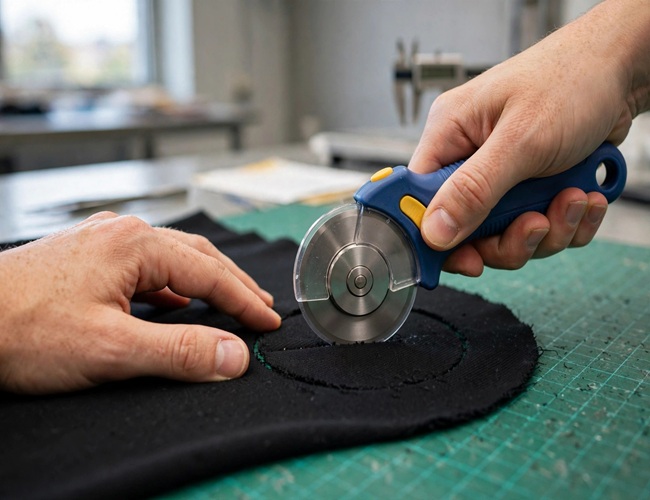
Cutting a 100 cm² circular sample with a GSM cutter the standard method in textile labs.
One practical tip: change the cutter blade regularly. A blunt blade drags and frays the sample edges, and frayed edges mean missing fibres — which means a wrong, low reading.
Method 2: Without a GSM Cutter
No cutter on hand? A ruler, scissors, and a small digital scale will do:
GSM = sample weight (g) ÷ (length in cm × width in cm) × 10,000
- Cut a neat square a 20 cm × 20 cm piece works well and measure it carefully.
- Weigh the piece on a digital scale.
- Apply the formula.
Worked example: your 20 cm × 20 cm piece weighs 7.2 grams.
7.2 ÷ (20 × 20) × 10,000 = 7.2 ÷ 400 × 10,000 = 180 GSM
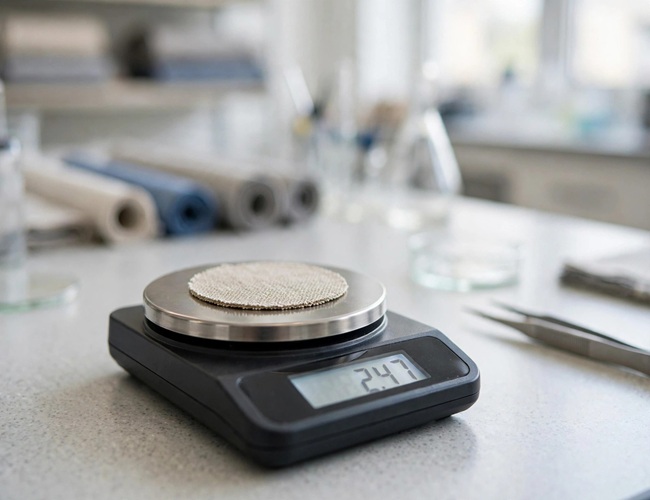
Weighing a fabric sample on a digital precision balance the reading goes straight into the GSM formula.
Hand-cutting is a little less precise than using a cutter, but for factory floor checks and costing estimates this method is perfectly good enough.
Converting GSM to Ounces (oz/yd²)
American buyers often specify weight in ounces per square yard. The conversion factor:
1 oz/yd² = 33.91 GSM (so: ounces = GSM ÷ 33.91)
- 180 GSM ÷ 33.91 = about 5.3 oz
- 12 oz denim × 33.91 = about 407 GSM
Keep this number handy. Denim is almost always discussed in ounces when a buyer asks for “12 oz denim,” they mean roughly 407 GSM.
Two international standards govern fabric weight testing: ASTM D3776/D3776M (Standard Test Methods for Mass Per Unit Area (Weight) of Fabric) and ISO 3801 (Textiles Woven fabrics Determination of mass per unit length and mass per unit area). If a buyer disputes your reading, testing to one of these standards settles the argument.
GSM Weight Classes
Fabric weights fall into three simple classes:
|
Weight class |
GSM range |
Typical uses |
|
Lightweight |
Below 150 GSM |
Summer T-shirts, voile, lawn, |
|
Midweight |
150–250 GSM |
Regular T-shirts, polo shirts, |
|
Heavyweight |
Above 250 GSM |
Hoodies, fleece, denim, jackets |
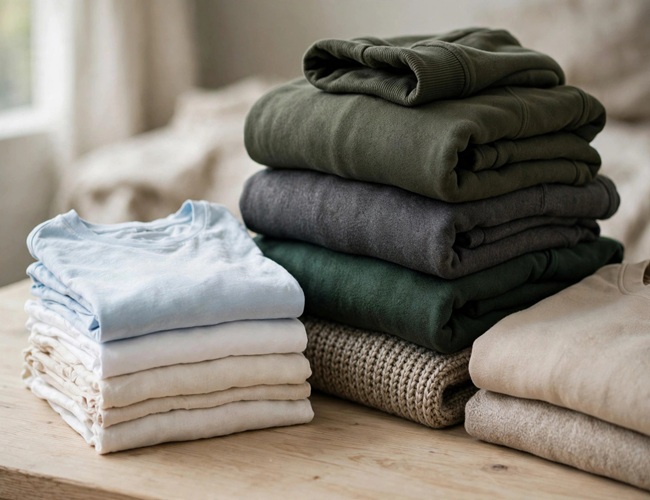
Light summer tees and heavy hoodies side by side the visible difference that GSM puts a number on.
Recommended GSM by Garment Type
A practical desk reference. These are normal industry ranges the buyer’s tech pack is always the final word:
|
Garment |
Recommended GSM |
|
Basic T-shirt |
140–220 (lightweight summer |
|
Polo shirt (pique) |
200–240 |
|
Hoodie / fleece |
280–400 |
|
Sweatshirt |
260–350 |
|
Denim jeans (10–14 oz) |
340–475 |
|
Formal shirt (poplin/oxford) |
100–140 |
|
Leggings |
200–280 |
|
Towel |
450–600 |
|
Bed sheet |
120–150 |
What Affects GSM?
GSM is built into the fabric at every production stage:
- Yarn count. Finer yarns make lighter fabrics; coarser yarns make heavier ones.
- Stitch or loop length. In knitting, longer loop length means fewer loops per square centimeter and lower GSM.
- Machine gauge. Finer-gauge machines produce lighter fabric; coarser gauges produce heavier fabric.
- Fabric structure. Interlock is heavier than single jersey of the same yarn; fleece, with its brushed back, is heavier still.
- Compacting, heat setting, and chemical finishes can shift the final GSM by a surprising amount.
- Moisture content. Wet fabric weighs more another reason samples must be conditioned before testing.
New merchandisers often check GSM only on the approved sample and forget that it can shift after bulk finishing. Always recheck GSM on bulk production fabric.
GSM and Fabric Cost: Why a Few Grams Matter
Knit fabric is priced per kilogram. If a T-shirt uses 220 grams of fabric at 160 GSM but 260 grams at 190 GSM, that extra 40 grams per piece adds up fast. On an order of 50,000 dozen, a few grams of GSM difference can mean tonnes of extra fabric extra cost, and potentially a fabric shortage that stops production. Mills guard GSM carefully for exactly this reason: overshoot and they give away free weight; undershoot and the shipment gets rejected.
How to Choose the Right GSM for a Garment
Match GSM to the season, the garment type, the buyer’s tech pack, and the price target:
- Summer wear: go light. A 150 GSM tee sells in summer; a 220 GSM tee sits in the warehouse.
- Winter and casual wear: go heavier. A hoodie at 280 GSM feels flimsy; at 320–350 GSM it feels premium.
- Formal and office wear: keep it light and crisp formal shirts work best around 100–140 GSM.
- Watch the price target. Do not chase higher GSM blindly. Extra weight raises cost per piece and can make a summer garment genuinely uncomfortable. The right GSM satisfies the buyer, suits the season, and keeps costing healthy.
Frequently Asked Questions
Is higher GSM always better quality? No. Higher GSM means heavier, not better. Quality depends on yarn, knitting, dyeing, and finishing. A well-made 160 GSM tee can outlast a poorly made 220 GSM one.
What is a good GSM for a T-shirt? 160–180 GSM is the sweet spot for a regular everyday T-shirt. Summer tees run 140–160 GSM; premium heavyweight tees run 200–240 GSM.
Is 180 GSM good for summer? In mild weather, yes. In very hot, humid weather like a Bangladeshi summer most buyers prefer 140–160 GSM for breathability.
How do I convert GSM to ounces? Divide by 33.91. For example, 180 GSM ÷ 33.91 = about 5.3 oz/yd².
The Bottom Line
GSM is a simple number, but it touches almost everything a merchandiser does costing, quality, production, and customer satisfaction. Measure it properly, recheck it in bulk, and choose it with the season and the buyer in mind. Get GSM right, and a surprising number of other things fall into place.

Mohammad Noor Nabi, known by his author name Noor Ahmed Raaz, is a PhD Fellow at Bangladesh University of Textiles (BUTEX) and the Founder & Editor of Textile Merchandising. He is also an Assistant Professor of the Textile Engineering Department at a renowned university in Dhaka, Bangladesh. His research focuses on textile innovation and sustainability. Awarded the Research & Development Fellowship thrice from the Ministry of Science & Technology in Bangladesh, Noor Ahmed Raaz is dedicated to advancing textile engineering through education, research, and industry collaboration. For inquiries or collaborations, contact Noor Ahmed Raaz via email at textilemerchandising1@gmail.com or WhatsApp at +8801673758271.