


Garment Costing Explained: How to Prepare a Complete FOB Cost Sheet
Noor Ahmed Raaz
Specialized in Apparel Manufacturing
Owner and Editor in Chief Textile Merchandising
Asst. Prof., Department of Textile Engineering
Atish Dipankar University of Science & Technology
Email: textilemerchandising1@gmail.com
A few years back, I watched a factory lose money on a 50,000-piece T-shirt order. Simple style, smooth production, happy buyer — but the shipment closed out at a loss. Why? The merchandiser had quoted the FOB price using last season’s fabric rate, and yarn prices had moved up before bulk booking. Nobody re-checked the numbers.
That lesson sticks with you: costing is the merchandiser’s most important skill. Everything else sits on top of the price you quoted. Get it right and the order earns money. Get it wrong and nothing else can save it.
What Is Garment Costing?
Garment costing is calculating the total cost of producing a garment so you can quote the right price: add up fabric, trims, labor, washing, packing, overheads, then add your profit margin.
New merchandisers tend to rush this part — fabric price from memory, guessed consumption, a trim or two forgotten. Costing rewards the opposite: slow down, check the tech pack line by line, and use fresh numbers.
Three Terms You Must Know: FOB, CM, and CMT
- FOB (Free on Board): The price the factory quotes the buyer for the finished garment, packed and ready, delivered to the port. When a buyer asks “what’s your price?”, this is the number they mean.
- CM (Cost of Making): The cost of cutting and sewing — labor and machine time only, no materials. CM depends on the garment’s SAM (standard allowed minutes) and the line’s efficiency.
- CMT (Cut, Make, Trim): CM plus trims. Confirm with the factory which one you’re being quoted.

A merchandiser at work: calculator, cost sheet, fabric swatches, and the garment sample the basic toolkit of garment costing.
The Cost Components, One by One
Every FOB cost sheet is built from the same blocks. Learn them in order and you’ll never leave a line out.
1. Fabric (50–70% of total cost)
Fabric is the elephant in the cost sheet half to two-thirds of the total. A small error here hurts more than anywhere else. You need two numbers: consumption (fabric per garment) and fabric rate (price per kg or yard). Get consumption from the marker or a verified chart, add 3–5% wastage, and always call the supplier for today’s rate. Never cost fabric from memory.
2. Trims & Accessories
Everything except fabric: thread, labels, hang tags, buttons, polybags, cartons. Cheap individually, real money together. Pull the full trim list from the tech pack’s BOM and price each item with a fresh quote. In my experience, forgotten trims are one of the most common reasons quotes come out too low.
3. CM Cutting & Making
CM covers cutting, sewing, and finishing labor. It comes down to SAM (minutes needed per garment) and line efficiency (how much of that time actually produces). Similar-looking CM rates can hide very different efficiencies ask how the rate was derived.
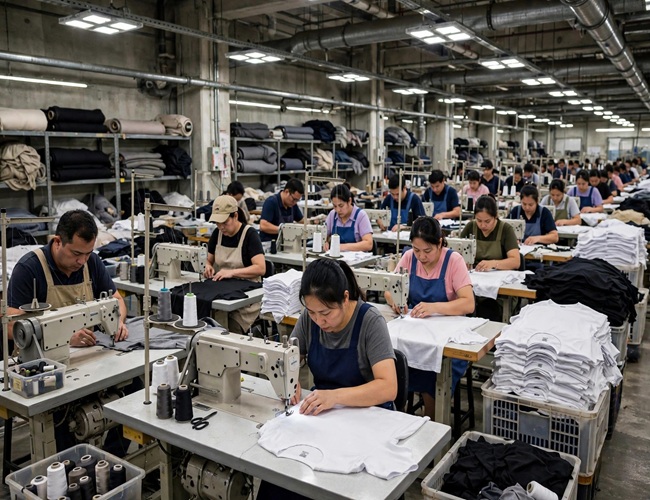
The sewing floor, where CM is earned: labor cost depends on SAM and line efficiency.
4. Washing
Enzyme, silicone, stone wash for denim add it as a separate line. Washing charges depend on the recipe and lot size; small lots cost more per piece.
5. Printing & Embroidery
Priced per impression or per thousand stitches. Confirm artwork size, placement, and colors before costing — one extra color changes the rate.
6. Testing & Inspection
Lab testing (colorfastness, shrinkage, chemical tests) and final inspections are increasingly required. Budget for them per style or order and remember that a failed test means paid retesting.
7. Packing
Polybags, cartons, tissue paper, silica gel, barcode stickers priced per garment. If the buyer wants special packing, cost exactly what they ask for.
8. Commercial Cost & Overhead
The factory’s cost of doing business: bank charges, documentation, forwarding fees, office expenses. Common practice is 4–6% of the subtotal.
9. Profit Margin
Basics often run 5–10%; fashion styles can carry more. Quoting with no margin to win an order is a short-term tactic you have no buffer when something goes wrong.
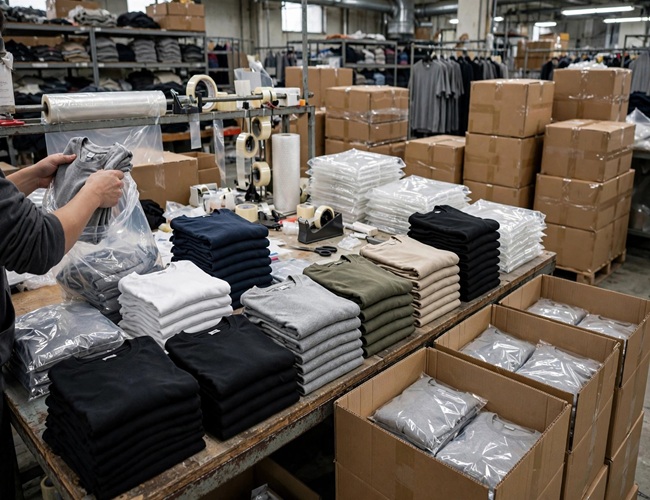
Final inspection and packing: folded garments, polybags, and cartons ready for shipment.
The FOB Formula
The whole cost sheet boils down to one line:
FOB = Fabric + Trims + CM + Washing + Print/Embroidery + Testing + Packing + Commercial & Overhead + Profit
Worked Example: Basic Men’s T-Shirt
Let’s cost a real garment: a basic men’s T-shirt in 180 GSM single jersey. Complete cost sheet (figures rounded):
|
Cost |
Basis |
Cost |
Cost |
|
Fabric |
2.2 |
$11.44 |
$0.95 |
|
Trims |
BOM items |
$2.16 |
$0.18 |
|
Chest |
Per |
$0.84 |
$0.07 |
|
CM |
Factory rate |
$6.60 |
$0.55 |
|
Garment |
Enzyme |
$0.60 |
$0.05 |
|
Testing |
Lab + inspection |
$0.36 |
$0.03 |
|
Packing |
Polybag |
$0.72 |
$0.06 |
|
Subtotal |
|
$22.72 |
$1.89 |
|
Commercial |
On |
$1.14 |
$0.09 |
|
Running |
|
$23.86 |
$1.98 |
|
Profit |
On |
$2.39 |
$0.20 |
|
FINAL |
|
$26.25 |
$2.19 |
Note the order: overheads go on the subtotal, and profit goes on top of everything. Put profit on too small a base and you quietly shave your own margin.
Typical Cost Shares in a Basic Knit Garment
Not every style looks like this T-shirt, but this pattern is worth memorizing it lets you sanity-check any quote.
|
Cost |
Typical |
|
Fabric |
50–70% |
|
Trims |
5–10% |
|
CM |
15–25% |
|
Wash / |
2–8% |
|
Testing |
3–6% |
|
Profit |
5–15% |
Shares move with the style and buyer a fashion jacket shifts weight toward CM and trims; a basic tee sits firmly in the fabric column.
Golden Rules for Accurate Costing
- Use fresh supplier quotes. Never cost fabric or trims from memory get today’s rate.
- Calculate consumption precisely. Use the actual marker or a verified figure, then add wastage. A 2% fabric error costs more than getting every trim wrong.
- Cross-check trims against the BOM/tech pack. Tick off each trim line by line. If the tech pack doesn’t list it, ask before assuming.
- Allow for wastage and shrinkage. Fabric shrinks in washing; cutting leaves end-bits and damages. Build in realistic allowances, not hopeful ones.
- Watch exchange rates and respect the MOQ. If you buy in one currency and quote in dollars, note the rate you used — a moving rate can eat your margin mid-order. And cost the actual order size: small quantities raise per-piece costs for fabric, printing setups, and testing.
Common Costing Mistakes That Lose Money
- Using an old fabric price. Last season’s $5.00/kg may be $5.40 today across 50,000 pieces, that difference is brutal.
- Forgetting a trim. One unpriced hangtag across 100,000 pieces is a five-figure surprise.
- Quoting before sample approval. If the buyer later adds a print or changes the fabric, your quote is already in their hands. Cost the approved sample, or mark the quote provisional.
- Ignoring re-inspection and retest charges. A failed lab test means paid retesting and it should be in your risk buffer.
FAQ
What is the difference between CM and CMT? CM is cutting and making labor only. CMT adds the trims. Factories often use the terms loosely, so confirm which one you’re getting.
What does the FOB price include? Everything up to the port: all materials, labor, overheads, and the factory’s profit. It excludes ocean freight and insurance those are the buyer’s side under FOB terms.
How much profit margin is normal? For basics, 5–10% is typical; fashion and complex styles can carry 10–15% or more. Anything lower leaves you exposed when the inevitable problem shows up.
Why do two factories quote different prices for the same style? Their costs genuinely differ: different fabric rates, different SAM and line efficiency (so different CM), different overheads and margins. A much cheaper quote usually means cheaper fabric, lower efficiency, or a margin too thin to absorb problems. Ask what’s behind the number before chasing the lowest price.
Conclusion
Start from the tech pack, price every component with fresh numbers, follow the formula, and add margin last. The merchandiser who costs carefully earns something no sales pitch can buy: the confidence to negotiate knowing exactly where every cent goes.Try it yourself: take the worked T-shirt example and re-cost it with real quotes from your own suppliers. The first time you build a cost sheet from scratch, costing stops feeling like theory and starts feeling like the most powerful tool in your job.

Mohammad Noor Nabi, known by his author name Noor Ahmed Raaz, is a PhD Fellow at Bangladesh University of Textiles (BUTEX) and the Founder & Editor of Textile Merchandising. He is also an Assistant Professor of the Textile Engineering Department at a renowned university in Dhaka, Bangladesh. His research focuses on textile innovation and sustainability. Awarded the Research & Development Fellowship thrice from the Ministry of Science & Technology in Bangladesh, Noor Ahmed Raaz is dedicated to advancing textile engineering through education, research, and industry collaboration. For inquiries or collaborations, contact Noor Ahmed Raaz via email at textilemerchandising1@gmail.com or WhatsApp at +8801673758271.